Showing posts with label Nepal. Show all posts

Thursday, 19 June 2014

An unusual sight in modern times

As I walked to Aro Ling Cardiff this morning, I was struck by the unusual nature of this scene.


No, I do not mean the blue sky! This is Court Road without a single parked car. I am certain that I have never seen this road empty before.

It is said that in the Wild West, walking was what you did to get to your horse. In modern times in the West, walking is what you do to get to your car. It is also notable that the street is completely empty. As I walk to work I see few pedestrians – usually just a few dog walkers. It is not until I approach the shopping area of Whitchurch Village that I start to see people on foot. I see even fewer people walking in inclement weather and in the winter.

I am struck by the contrast of my experience of Kathmandu.


There everyone lives and conducts their social and business life on the street as much as in their homes. This one of the things I enjoy about being in Nepal. Perhaps it has something to do with climate. It does rain a lot in Wales so it is not practical to be out on the streets so much. I suspect, however, that cars have a great deal to do with the structure of modern society.

I am not anti-car – we have one; I enjoy driving it; I value its convenience. We did not own a car for about 10 years and life was quite hard. I damaged my knees hauling shopping home, and little fat children to and from school in a trailer pulled by my bicycle. I would not go back to not having a car, but I try to use it only when it is necessary and walk to work even in the rain.

Saturday, 10 May 2014

Six Days in Nepal VI


This is the last of my posts about our whirlwind visit to Nepal. We had hoped to vist Nagi Gompa, high above the city, on our last full day – but once again it was not to be. Perhaps I will never go there again now. Instead we accepted invitations to attend Dakini Day practices at Rigon Tashi Choeling, and Pal Gyi Ling – the monasteries of Namkha Dri’mèd Rinpoche and Lama Wandü. Our group divided with half going to each event.


The tsog’khorlo rite at Pal Gyi Ling began at 08:30 and finished at 18:30 with a two hour break at noon. It was a powerful event with a monk gékor and a ngakpa gékor (master of ceremonies). We were most honoured to be treated as sangha, and were given pandit hats to wear at the appropriate moments. We had no text and there was no translation available, so we put on the hats when they did, threw rice when they did, and practised mantra throughout the day. Dorje Tsig Dün and the Lama’i Naljor of Ma-gÇig (Machig) Labdrön both scan with their delightful tunes, so I also quietly practised these at times during the ceremony. For a long time we respectfully refrained from taking photographs, but when we saw monks taking shots and even videoing things, we decided it was probably okay to take a few.


During the morning session we were sitting opposite one of the gékors, Ngakpa Dawa, and it was magical hearing his powerful voice and watching his fluid and elegant mudras. There were three Ngakpas taking part in the rite and about twelve or fifteen monks. Right in front of us sat two very young monks.
Ngakpa Dawa
After the lunchtime break, Lama Wangdü led proceedings. As he came into the Gompa he greeted people, and when he spotted our group he came over and sang a line of the Lama’i Naljor of Ma-gÇig (Machig) Labdrön to each of us. We were positioned behind his throne, so we were not able to see much of him during the ceremony, but he had a fabulous gÇod (chöd) drum and an amazing hat with a bird at the front point. Ngakpa Dawa had been wearing the same type of hat until Lama Wangdü arrived. Lama Wangdü gave him and two monks gékor hats which they wore, when appropriate, for the rest of the ceremony. The number of people in the Gompa increased considerably in the afternoon—Tibetans, Westerners, visiting monks and nuns— and extra rugs were laid out for them to sit on.

It was an extraordinary practice with all the offerings thrown on a large bonfire in the courtyard of the monastery. At one point we all went out to the bonfire and witnessed a large torma and many other things thrown into the fire. Lama Wandü seemed to enjoy throwing things on the fire so that there was a burst of bright flame. It was quite theatrical. We then had to walk three times round the fire clockwise, and three times anitclockwise before returning to our seats in the Gompa.


Only pre-prepared bags of food were given out apart from a spoonful of fried potato pieces. Money was also given to the practitioners – including us! When the rite was over, Lama Wangdü struggled down from the throne seeming stiff and in difficulty. Yet when he came to our group as he was leaving the gompa, he again greeted us with the lines of Lama’i Naljor and even performed a little vajra dance as he sang. So it was time to leave, with our bags of food and piles of money. We all put most of the money into the monastery’s donation box. The rest, and the food, we gave to beggars on our walk home.


Just as we were leaving, a monk urgently indicated that we should not. We eventually realised that he was insisting that we joined the monks for a meal. So we went to the dining room and had a fast, but tasty meal in the gloom. As it was nearly dark by then, and there was a power cut, we could not see what we were eating, but it was good.

I felt a little choked up as we finished the day with a few rounds of kora at the Great Stupa, knowing it may be the last time I was ever there. ’ö-Dzin gets too sick in Kathmandu with his chest, so we may well never go again unless they sort out the pollution problem. It was a most special trip and I will always treasure the memories of it.

Friday, 9 May 2014

Six Days in Nepal V

After our visit to Rigon Tashi Choeling we carried on to Pharping. When we first visited Pharping it was a small rural village. There was one road that went up to the monastery and another dirt road with a few shops. At the time—2007—the place reminded me a little of a Western frontier town. It had something of that feel of being in transition and slightly wild. Now ‘civilisation’ and ‘progress’ has definitely arrived at Pharping and it now feels like a tiny Kathmandu.

Fortunately the area with the Padmasambhava caves is still only accessible by foot and remains much the same.
Padmasambhava’s hand print in the rock


As we walked down from the caves to get back to the coach for the journey home, we passed a group of monks playing cricket. There was something rather inspiringly matter-of-fact about the rolled up monk’s skirt and their T-shirts with the stupa and gompa in the background.

Kathmandu traffic from the coach

Thursday, 8 May 2014

Six Days in Nepal IV

After our audience with Namkha Dri’mèd Rinpoche we went to his monastery in Pharping, Rigon Tashi Choeling. It was established in November 2005, and is an exquisite and extraordinary place. Every inch of it has an interesting detail and I took many, many photographs. Above the main shrine room there is a special Ling Gésar shrine room which we were privileged to also be able to see. Photography was not allowed inside the Gompa.

The entrance to the Gompa
Tiger above the entrance
Snow Lion
Garuda
Dragon
Makara waterspout

From the roof of the Gompa we could see a statue of Padmasambhava under construction. It will be wonderful when it is finished.

Roof detail
Dorje (vajra) detail in the wrought iron fencing


Tuesday, 6 May 2014

Six Days in Nepal III

We met some amazing people during our whirlwind trip to Nepal – renewing some acquaintanceships and making new ones.

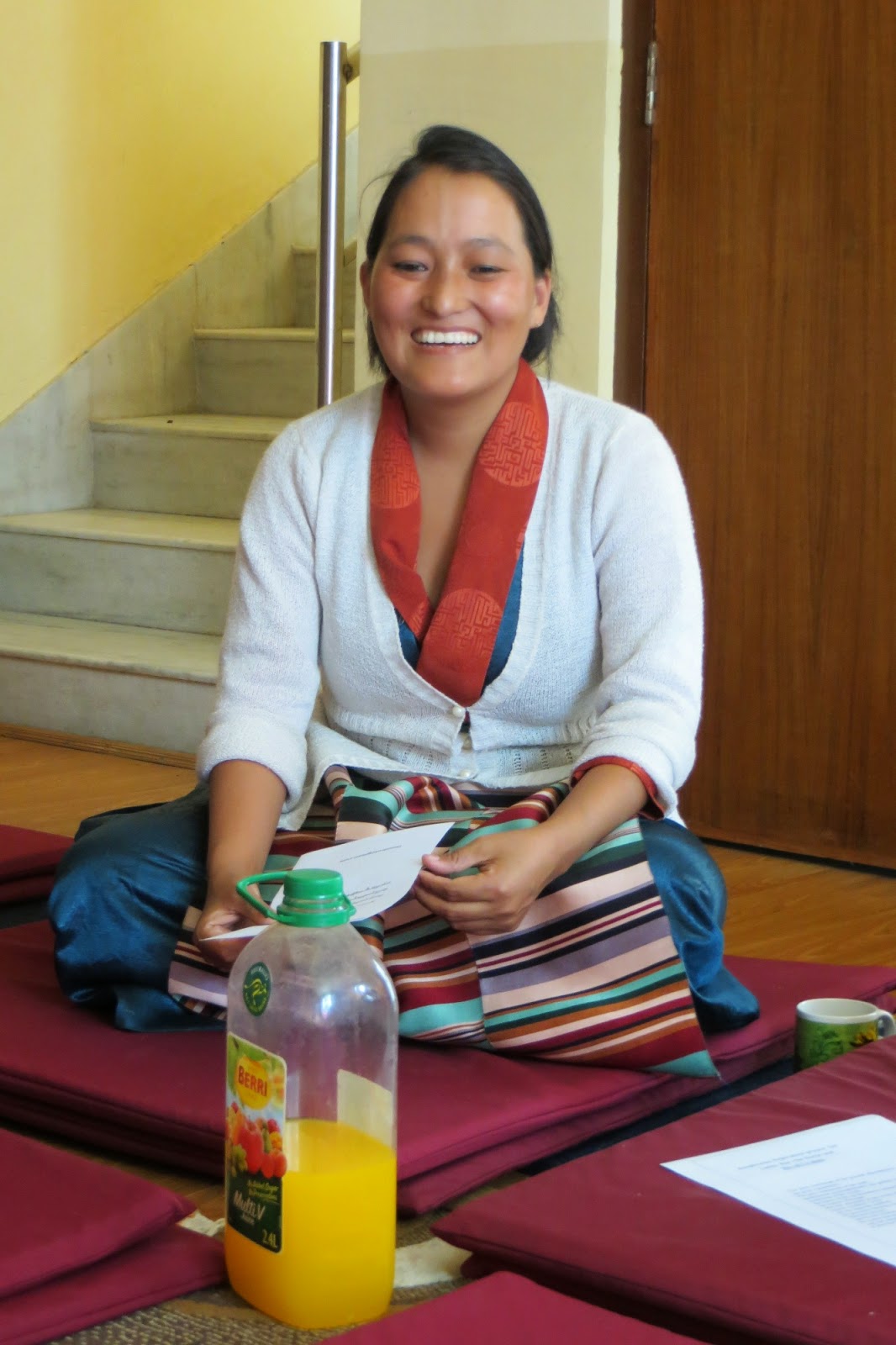
Lhamo Yangchen is the wife of Sangngag Rinpoche. She is a most kind and delightful person. She invited our group over for tea on the day after we arrived. Llamo also acted as translator for us when we visited Jomo Samphel Déchen, and when ’ö-Dzin saw Doctor Wangchuk.

Llamo Yangchen
On our second day in Kathmandu half our group went to Pal Gyi Ling, the monastery of Lama Wangdü. He was receiving visitors in small groups in the mornings, and we waited in line till it was our turn. Lama Wangdü holds a gÇod (chod) lineage that has come down from Ma-gÇig (Machig) Labdrön and Padampa Sang-gyé. He asked us about our practice so we sang the Lama’i Naljor of Ma-gÇig Labdrön. He then sang it back to us with a different tune. He was very jolly and friendly.

The next day we visited Jomo Samphel Déchen, wife of the late Kyabjé Künzang Dorje Rinpoche. She is an extraordinary Lama who radiates with awareness and kindness.
Jomo Samphel Déchen
One our fourth day in Nepal we were most fortunate to be granted the possibility of an audience with Namkha Dri’mèd Rinpoche. His personality was quite a contrast to Lama Wangdü: he was restrained and serious. He asked some penetrating questions about our practice. Toward the end of the audience Namkha Dri’mèd Rinpoche seemed satisfied with us and was happy for us to take photographs.

Namkha Dri’mèd Rinpoche
On our final day, before the day of travelling home, we had intended to take a taxi up to Nagi Gompa and then walk back down. We visited Nagi Gompa on our first trip to Nepal in 2007 and each visit since then circumstances have arisen that have prevented us going again. 2014 was no exception – invitations were received for us to take part in Dakini day tsog’khorlo ceremonies so that is what we did. Lama Bar-ché led half of our group to Namkha Dri’mèd’s monastery and we led the other half to Lama Wangdü’s monastery. More of that later . . .


Monday, 5 May 2014

Six Days in Nepal II

We did not have much time free this visit to spend at the Great Stupa. It is as magnificent and moving as ever, and beautifully maintained. It looked white and pristine, and as though the fluttering fabrics had been renewed. Once again we witnessed the painting of the lotus flower shapes on the dome. It is always fascinating to watch the skill and simplicity of throwing the yellow liquid at the precise angle to enable it to land as a curve on the surface of the white dome. Previously we had seen them painting the lower petals from below. This time we witnessed them painting the upper petals from above.


Thank you to Ta'tsal for taking our picture.


Sunday, 4 May 2014

Six days in Nepal I

We have recently returned from a whirlwind six day visit to Nepal. It was a wonderful trip with many inspiring experiences.

Here are two views from our hotel window. This one was taken in the afternoon when the hills have become visible through the Kathmandu smog.  For some reason the pollution cleared somewhat during the day.


This photo was taken first thing in the morning from our balcony. The surrounding mountains are not visible at all.


Every time we visit Nepal—this is our fourth stay in Kathmandu—the pollution is a little worse and more difficult to cope with. This visit we went armed with N95 particulate respirator masks which are supposed to catch everything. We wore them everywhere except in the vicinity of the Great Stupa which is still relatively clear. We also kept the curtains drawn in our bedroom all the time which at least kept the dust out.

I love Nepal and enjoy the friendly frenzy of Kathmandu, but it is not a healthy place to visit. I think the Nepalese government will have to start to do something about it soon. I don't know how their people manage to survive it.

Saturday, 19 April 2014

Pilgrimage

One of the street beggar friends we hope to meet again.

We are about to leave for Kathmandu in Nepal. This will be our fourth visit, and the first time that we have not travelled in mid-winter. We are looking forward warmer weather—especially at night—and possibly less air pollution. In the winter every street corner has someone burning a pile of rubbish to try and stay warm and they burn everything and everything, including plastics. I hope we will be able to visit Nagi Gompa this trip, as it was not possible last time. I would dearly love to go there and enjoy the walk back down one more time.

Also—if the air quality is better—we may see the mountains. It was never clear enough to see them on our last visit and we were on the wrong side of the aircraft to see them on the flight home. It will be my first time in Nepal as an aspiring photographer. I am so looking forward to taking lots of photographs.

Thursday, 5 January 2012

Yang-le-shöd

Yang-lé-shöd (Pharping in Nepali) is the sacred place where Padmasambhava and Yeshé Tsogyel manifested as Dorje Phurba and Dorje Phagmo: the thunderbolt nail and the thunderbolt sow.  There are a number of monasteries in the area and also several caves.  The Asura cave is the most well-known and has the imprint of Padmasambhava’s hand in the rock outside it.  It is an electric experience to place one’s own hand into the rock imprint.  I am not very tall and could only just reach to place my hand, and hence could not see the imprint very clearly.  It was extraordinary therefore, to look at ’ö-Dzin’s photograph of the hand print when we got home and see the fluid quality of the rock – exactly as if the rock had melted around Padmasambhava’s hand.  I feel so fortunate to have had the opportunity to place my hand in this imprint and feel a connection with the Tantric Buddha through my practice.

’ö-Dzin also spotted this small tsa-tsa of Padmasambhava in the rock.
We then walked up above the Asura cave and found a small chörten (stupa).  This rocky crag afforded a magnificent view across the fields and town with a backdrop of the mountains.

We sat and meditated for a while and sang Dorje Tsig Dün.  Then a rather strange thing happened.  A friendly little dog had followed us up to the chörten and had sat beside me.   As I began to sing, the little dog became excited and climbed into my lap, licking my face and hands.  It was an inexplicably moving experience.

From this point, and up to the top of the hillside, was completely criss-crossed with prayer flags.  A few of us climbed up higher, ducking under the strings of prayer flags.

The drive back from Yang-le-Shöd in the two ancient and rickety hired buses was hilarious.  The driver of our bus kept turning round – either to avoid traffic jams or, so it seemed to us, because he was lost.  At one point he was driving the wrong way down a one way street.  We saw the extremes of Kathmandu that day: people living in shacks next to a rubbish dump, and a modern, new shopping mall that would not have looked out of place in any western city.  We lost track of the other bus and felt sure they would have been back an hour before us.  We found out later that they also had thought we would be home ages before them.  Then suddenly the two buses were in convoy again and we were practically at the hotel.  Amazing.

This was the last trip of the pilgrimage and this is my final post about it.  I am most happy to have had this experience one more time – especially as ’ö-Dzin and I do not feel we are likely to be going there again.

Tuesday, 3 January 2012

Visiting Monasteries in Boudhanath

We visited a number of monasteries in the Boudhanath area of Kathmandu.  They are all beautifully decorated and well maintained.
Shechen Monastery
They were practising tsog’khorlo (gana puja).
Decoration and a plaque at Shechen Monastery
The White Monastery – which they kindly opened for us.  Also known as Ka-nying Shédrüb Ling.  A Kagyu-Nyingma monastery.
I love the way the monks leave their robes – almost as if they are still there.
Finally we visited Düd’jom Monastery which is off the main street and does not have such an impressive frontage.  Inside however it was the most inspiring with many wonderful statues and a feeling of being a place of continual dedicated practice over a long period of time.

Sunday, 1 January 2012

Kathmandu

Several expeditions were planned for the pilgrims while we were in Kathmandu.  Two of these went forward—a visit to the nearby monasteries and a trip to Yang-le-shöd (Palping)—but the third—visiting Nagi Gompa—had to be cancelled.  We were sad not to be able to visit Nagi Gompa again, but at least we had had the opportunity to visit there on our first trip to Nepal.  In this post I am including pictures of Boudanath and meetings with Lamas.  I will create two separate posts for the visit to the monasteries and Yang-le-shöd.

The street from our guest house to the stupa.
Visiting Kathmandu is a pilgrimage for the Confederate Sanghas of Aro, but there are also opportunities to purchase things that are difficult to find at home.  We bought a gZi stone for our elder son who is an apprentice of Naljorpa Bar-ché,  We purchased cases for our rolmo and ting-shar and are delighted that they are of perfect in size.  ’ö-Dzin and I each bought new teng-gars (malas – prayer beads) and also a set for our younger son.  There are now a couple of good bookshops near the stupa and we found a few interesting books.  We had some robes and other clothing made for us by our favourite tailor.  Many sangha members were having robes made and it was a busy few weeks for Norzin Tailors.

An incense shop.
There were approximately 60 Aro sangha members on pilgrimage together when everyone assembled in the week our Lineage Lamas were present.  Various individuals stayed for extended periods before and/or after the Lineage Lamas’ visit.

Many gZis for sale in Lumbini mala shop.  These are not the highest quality but are stone rather than glass and very nicely marked.  We bought Daniel a 9-eyed stone very like the one in the bottom right corner of the picture.
Tenzin Dölma is looking after Norzin Tailoring for her sister Palmo while she is away.  Norzin is the name of Palmo’s daughter. Tenzin worked hard and was most efficient in getting everything ready on time.  The tiny shop is packed from top to bottom with garments.
I rather liked this hat but felt that although it would be fine to wear in Kathmandu I would never wear it at home.  Perhaps this will be the ‘wish I’d bought that’ from this trip.
There is a monastery right next to the guest house, and others all around.  It is splendid to go up onto the roof and look around at all the signs of Buddhist practice and hear Tibetan instruments and chanting.
One of our main practices while in Boudhanath is kora – circumambulation of the stupa practising mantra.  Here we were practising as a group.  Tibetans usually practise kora twice: early in the morning and at around 4 pm.
I was delighted to have the opportunity to meet Khandro Ten’dzin Drölkar – a great Lama and one of Ngak’chang Rinpoche’s first teachers.
We also had a lovely visit from Jomo Samphel Déchen – the sang-yum (spiritual wife) of the late Kyabjé Kunzang Dorje Rinpoche.  She spoke at length about her early life – but the translator spoke so quietly that none of us could hear him.  Fortunately it was recorded and I look forward to hearing that sometime.
This is the Lama of the monastery next door to the guest house.  His name is Sang-ngag Rinpoche.  He heard us singing seven line song (Dorje Tsig Dün) before meals at the guest house and invited us all to visit him and his wife, Lhamo Yangchen.  We all followed her round to the monastery and had a delightful time with them drinking tea and eating biscuits.  They had been reading Ngak’chang Rinpoche’s latest book, Wisdom Eccentrics*, and thoroughly enjoying it.  It was wonderful to make this friendly connection with these Nyingma practitioners.
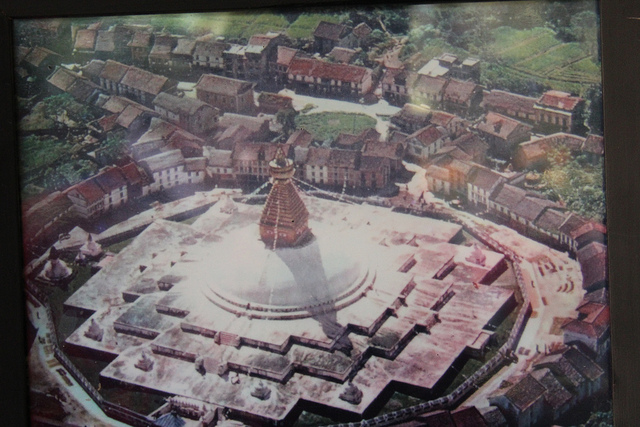
A number of the restaurants near the stupa have photographs and drawings of Boudhanath in the past.  This is a picture from the 1970s when Boudhanath was a small village clustered around the stupa and surrounded by fields rather than being subsumed in the urban sprawl of Kathmandu.
Only one day during our 10 days in Kathmandu did the air clear sufficiently to catch a glimpse of the Himalayas.
* Wisdom Eccentrics by Ngakpa Chögyam is published by Aro books.