Showing posts with label Buddhism. Show all posts

Saturday, 3 September 2022

Catching up on writing, creativity, Buddhism and life in general

Well hasn’t it been an interesting time over the past two or three years! 

It feels like a period of time has been lost, because of the pandemic – and yet it has also been a very busy time. There have been some quite radical changes in our life through this period, which is probably true for many people. In this post—my first since 2020—I offer a sketch of these changes.

My husband, Ngakpa ’ö-Dzin, retired from full-time employment in May 2019. It is quite an adjustment to move from being at home alone all day, five days a week, to almost never being at home alone. The transition has been gradual and creative and we are both enjoying having so much time together.

Because of the pandemic, physical attendance at Aro Ling Cardiff had to cease. We changed our weekly meditation group to a virtual meeting on Zoom. This has been most successful. For two years we included a short teaching as part of the meeting and these have been posted to YouTube. No longer needing premises for Aro Ling Cardiff created the unexpected benefit of being able to offer this space to our son to live when life became difficult for him during the pandemic. 

Battlecry of Freedom—my book about Mind Training (bLo sByong – Lojong—was published in 2019, and has been well received. It is published as a paperback and an e-book at Lulu, and available in all the usual channels, such as Amazon, Kindle, Barnes & Noble, and so on. I also created slogan cards, which can be purchased at makeplayingcards.com.

My next book, Travelling at the Speed of Mind, will hopefully be published by the end of the year.


As ever, I have continued with craft work, making items for myself, the home, and also for our grandchildren. The pictures are of the blankets I made for them last Christmas.

I have bought a knitting machine and a peg loom, and recently learned a new technique: fingerloop braiding. I’ll leave that for another post.

I did not continue with the Art Journalling for several years, having rather lost my inspiration. I also stopped tangling. However I have recently revived this interest and am enjoying drawing again.


Another new venture is the creation of my store at RedBubble. I’m not expecting to earn anything from it, but it is such fun to see my artwork on all sorts of items, such as mugs, T-shirts, scarves, bags, and so on. They will make nice presents if nothing else.


I’ll stop here because this is getting quite long. I hope you have safely come through the pandemic and any other crises – such as Brexit in the UK. To finish, here are the details of our weekly meditation group which will start again on September 12th, marking the end of our summer break.

Monday Meditations.
7 - 8:30 pm on Zoom (UK time) every Monday.
Zoom meeting ID: 85249620913; Passcode: 640389.
Do join us for silent sitting and yogic song, with a short teaching in the middle.

The meetings are hosted by Ngakma Nor’dzin and Ngakpa ’ö-Dzin, an ordained teaching couple of the Aro gTér Lineage. They dedicate their time to practice, teaching, the Aro gTér Lineage, and working with their students. Ngakma Nor’dzin is an award winning author. Her books are: Spacious Passion, Relaxing into Meditation, Battlecry of Freedom, and Illusory Advice (co-authored with Ngakpa ’ö-Dzin).


Tuesday, 30 October 2018

Battlecry of Freedom – joy and thanks for my favourite slogans

I love all of the slogans of Mind Training. I believe it is an extraordinary and liberating teaching.  I do, however, have two favourite slogans.

The first favourite is: Always be joyful – slogan 21.

There are many studies that have shown that if we smile, we do feel happier. It can be discovered, quite quickly, that if meditation is practised  regularly and consistently, joy arises spontaneously in the mind. Practice develops a sort of background happiness and joy.

Joy naturally arises from trusting beginningless awakened mind.
Joy naturally arises from letting go of self-centred protectiveness and having
a more expansive view. Awakening is joyful.

The mind does not need to be unseated from riding joy when mistakes are made or difficulties occur. If there is great sadness, it arises in the moment
and does not need to disturb the background potential of contentment.
When sadness dissolves, then joy is present again.

I am delighted that Pema Chödron used this slogan for the title of her book on the slogans of Mind Training.
A Celtic knot style horse motif I designed for use in the book.

My second favourite is the final slogan: Do not wish for thanks – slogan 59.

It makes me smile every time I read this one. So often we feel cheated if we do not receive a thank you  such as when you have politely waited to let another car go ahead of you and the driver doesn’t even acknowledge it. Do you ever feel ‘Where’s my thank you!?’ and perhaps even regret letting them go first just a little bit. I know I have done this, and immediately this slogan is there, reminding me to be a practitioner and get over myself. 

I also really like Chögyam Trungpa Rinpoche’s wording of this slogan: Don’t expect applause. 

Mind training is the greatest opportunity it is possible to be given in life.
Mind training is the path to awakening – to realise non-duality, to dwell in rigpa. Practitioners should not ask to be congratulated and thanked for training their minds.


If it is felt that thanks and applause are deserved, then there is still a lot of work to be done. Such an attitude is not awakened view, but rather, is somewhat ridiculous.

The practitioner may feel slightly embarrassed if they notice that they would actually quite like a standing ovation. Wryly recognise the wish for approval and appreciation,
smile at the recognition – and return to practice.


The reward of practice is the capacity for more practice.
Ultimately the reward of more practice is awakening.


Extracts from Battlecry of Freedom by Ngakma Nor’dzin, Part II – the slogans;to be published by Aro Books worldwide in 2019.


Wednesday, 17 October 2018

Battlecry of Freedom – slogan 12: Drive all blames into one

I think the slogan from the Seven Points of Mind Training that has most affected me in terms of the transformation of my view, is slogan 12: Drive all blames into one. This embraces the view of taking responsibility absolutely and completely without compromise.


Identity as a fixed, unchanging reality––as a thing that permanently abides––is the primary delusion. It is the source of all pain, aggression, hatred, prejudice, discrimination, disinterest. It is to blame for everything.

'If I am in the saddle, I have the identity of a rider. If I am in the stable grooming the horse, I have the identity of a groom. If I am lying in the dirt watching the horse disappearing down the trail, I have the identity of a pedestrian. 
The identity of rider dissolves into emptiness when I dismount. The identity of groom dissolves into emptiness when I leave the stable. The identity of pedestrian dissolves into emptiness when I find my horse grazing, and get back in the saddle. Identity arises, abides, and dissolves – as is the same with all phenomena. Any impression of continuation is illusory.' 

'The illusion of a self-existent identity is isolating and selfish
– I am in pain, which is much more important than your pain. 
The illusion of a self-existent identity prevents enjoyment and appreciation
– you are happy, but I cannot appreciate it, because it is not my happiness. 
Pain is pain – the identity associated with pain is irrelevant.
Practitioners wish to alleviate pain. 
Happiness is happiness – the identity associated with happiness is irrelevant.
Practitioners enjoy and appreciate happiness, and wish to increase it.
'

Even if there is no intention to harm from my own side, I am still the cause of others' pain. I am the object that made you angry  even though I didn't mean to. I am the person of whom you are jealous  even though I am just doing my own thing. I am the reason you felt overlooked and unloved  even though I didn't intend to ignore you. Taking the blame does not have to be associated with guilt and martyrdom. It is just recognising that everyone is confused and lacking awareness, and sometimes simply being there can aggravate that. It could be my delusion of an inherent identity that is the problem, or yours. The cause remains the same. Recognising this is driving all blames into one, and taking responsibility at a profound level.

'To take the blame for everything is to understand the root cause of all pain and unhappiness as the belief in an inherently existent identity. Practitioners take responsibility for this mistaken view. To be able to embrace the view of taking on the blame for anything and everything, is the most extraordinarily powerful practice of awakening.'

Extracts from Battlecry of Freedom by Ngakma Nor’dzin, Part II  the slogans;
to be published by Aro Books worldwide in 2019.

Thursday, 4 October 2018

Battlecry of Freedom; Mind Training, Lojong

Cover mock-up
I have been writing a book about Lojong—Mind Training—for the last two or three years. This Buddhist teaching is presented as 59 pithy slogans on how to train the mind, organised into seven points. It is a teaching that originated in the 11th century, and the Seven Points of Mind Training were composed by Chekhawa Yeshé Dorje (1101–1175). The book is going to be called Battlecry of Freedom as the word slogan originates from an ancient Celtic word meaning  battlecry. 
Writing the book has been quite a big project involving a lot of research. The research is essential, but in the end has to be discarded to a great extent, as the book itself must be written from the basis of practice and practice experience, rather than from intellectual study.
The reason for the picture of me on a horse on the cover, is that horseriding is a theme that is used throughout the book. Horsemanship and mounted warriorship has been an important aspect of Tibetan culture since ancient days, and the experience of training and riding a horse has many similarities to the experience of training and riding the mind. I have ridden horses throughout my life. Drawing on this experience and the relationship with horses, and through telling horseriding stories, I am able to present a view of the practice of Mind Training that is both traditional and personal.
When looking at the spiritual path, it can be useful to compare it to a more ordinary experience—such as horseriding—and leave aside the enigmatic and mysterious atmosphere of spirituality. This can make spiritual practice more approachable. Ultimately deep spiritual understanding is beyond words, because such understanding is beyond the capacity of intellect. This is also true of the deep relationship developed between a horse and rider.Ngakma Nor’dzin, Battlecry of Freedom, Aro Books worldwide, 2019
Battlecry of Freedom is in the proof-reading stage, and is expected to be ready for publication by the end of the year. It is time, therefore, to start presenting snippets to whet your interest.
A horse cannot be forced to cooperate with the rider, and will resent the attempt. Similarly the mind cannot be forced. This is easily discovered through trying to force thought to disappear.’ Ngakma Nor’dzin, Battlecry of Freedom, Aro Books worldwide, 2019

Wednesday, 3 October 2018

Lam Rim Buddhist Centre open day, September 30th


On Sunday I, and a group of Aro gTér Lineage practitioners, visited Lam Rim Buddhist Centre, near Raglan, South Wales. I worked out that it had been more than 30 years since we had last visited. Lam Rim was where my journey as a Buddhist began, and it was wonderful to return as an ordained practitioner.

’ö-Dzin took a photo of me at the driveway sign for Lam Rim in 1981, and again on Sunday. He has combined them in the image above. 1981 to 2018.

I found it very moving to sit and meditate in the shrine room at Lam Rim. So many memories of happy times flooded back. It also reminded me of being in Bhutan and experiencing the power of a shrine room that has been a place of practice for a long time.

Lam Rim is a Gélug Buddhist Centre, and we parted ways when I committed to the Nyingma School of Tibetan Buddhism, and to my root teacher Ngak’chang Rinpoche. This was absolutely the right move for me, as I could follow my aspiration to be a totally committed ordained practitioner, but without having to become a nun. I didn’t want to become a nun. There is no lineage of ordained, non-monastic practitioners in the Gélug School. ‘Householder’ lineages (gö kar chang lö) exist in the Kagyu and Sakya traditions as well, but are most evident in the Nyingma.

It is wonderful to be invited back to Lam Rim after all these years. It was a joyful and inspiring day. Teachers of many traditions taught there in its early years, and I in fact met Ngak’chang Rinpoche there when he was teaching. The book Rays of the Sun (Aro Books worldwide) was created from transcripts of his teachings at Lam Rim in the 1980s. I also met Khandro Déchen there, who became Ngak’chang Rinpoche’s sang-yum and wife, and also my root teacher. Lam Rim is now opening its doors once more to teachers of all traditions, and Ngakma Shé-zér, my vajra sister, will be teaching on yogic song on October 21st.

Who knows, perhaps ’ö-Dzin and I will be invited to teach there one day. This would indeed be an extraordinary and inspiring turning of the wheel of Dharma.

Thursday, 31 May 2018

Interfaith Conference

I took part in a most interesting Interfaith Conference a couple of weeks ago. It was organised by the Onyx Link Foundation, headed by the most kind and lovely gentleman, Dr Abdalla Mohamed OBE. There were presentations from a range of different faiths, and the atmosphere of the whole event was warm and inspiring. The theme was 'One Humanity, Morality, and Earth'. My presentation examined the enlightened potential of embracing friendship.

Giving my presentation

Receiving a beautiful cut glass vase
We were looked after royally at the hotel venue, and every presentation was interesting. I hope to be able to take part in more such inspiring events in the future. 

The conference is available to see on YouTube and my presentation is near the beginning of the second part.

Tuesday, 29 May 2018

New book in the autumn, and zentangles

I have been on something of a writing marathon for the first part of this year. The book is now written and is in its editing phase. This will also take some time, but I am confident that Battlecry of Freedom will be ready for publication in the autumn.

The book is about the Seven Points of Mind Training (bLo sByong -- Lojong) of ’Cad-kha-ba Ye-shes rDo-rJe (Chekawa Yeshe Dorje -- 1101-1175). The seven points contain fifty-nine slogans -- pithy sayings to remind you about practice, and I will be publishing sets of the fifty-nine cards to accompany the book. Here's an example of a slogan, picked at random:


DRIVE ALL BLAMES INTO ONE
le lan thams cad gCig la bDa’
The belief in an inherent self is to blame for all pain, dissatisfaction, and for cyclic existence.
Personally take the blame and accept responsibility for everything.
(Point 3: Transformation: 2nd of 6—12th of 59)


It has been my most challenging and inspiring writing project to date. I have thoroughly enjoyed the research, and also translating the points and the slogans from the Tibetan to try to engage with their essence. I hope it will be a useful book for Buddhist practitioners.

My other creative pastime is drawing zentangles. I am now part of a couple of groups who create zentangles in response to a challenge set every week. So usually I create one or two a week. I find this fun, relaxing, and creatively satisfying.


These were my first two tiles in response to the challenges. The top one is a challenge set by The Diva, #355. Other people's zentangles for this challenge can be found on Instagram by looking for #dc355. The bottom one is my Tickled to Tangle challenge #231. Adele Bruno sets these challenges and the many wonderful tiles can be seen on her blog.

Thursday, 23 November 2017

Bhutan Pilgrimage

Dordenma Buddha statue, Thimphu
I have just been fortunate in having the most amazing experience - a pilgrimage to Bhutan. It is an extraordinary country and the most civilised place I have ever been. They may not be at the forefront of development and modern living standards, but they absolutely understand that civilisation is not about how much you earn or how much you own. Their focus is on ‘Gross National Happiness’ and the West can learn a lot from them.
Dochula Pass
As a practitioner of Vajrayana Buddhism, it was so valuable to visit a Vajrayana country. Even more so than in Nepal or India, being a practitioner, and displaying that in my dress and demeanour, is totally understood and respected. The landscape is spectacular, and the manner in which they are protecting their religion, culture and heritage is exemplary. It is not possible to gush too much about Bhutan!

At Tak-tsang, Tiger's Nest
It is expensive to visit, but once you have arrived everything is taken care of - from bottles of water while travelling, to picnic lunches, to admissions to sites, and so on. There is no need to pay for anything extra if you do not want to. Our only real extra expenditure was donations at lhakhangs (temples). Our group has created a Flickr account with photos of the pilgrimage: https://www.flickr.com/photos/arobuddhism/collections/72157689770045215/

I have been able to meditate in some of the most inspiring places on Earth - places where Padmasambhava practised, as well as many other great historic practitioners. It has been inspiring beyond words.

Thursday, 10 November 2016

That word you keep using – I do not think it means what you think it means

Mandy Patinkin Inigo Montoya (Wallace Shawn Vizzini Andre the Giant Fezzik) Princess Bride That word it does not mean what you think it means

you keep using that word gif princess bride I do not think it means what you think it means Imgur

At the Interfaith Network UK meeting I was told a story that I found rather shocking. A lady told me that a Buddhist had been visiting to speak at their interfaith meeting. She enquired of a friend whether he and his wife would be able to attend. He replied that, no, they would not attend because it was a Buddhist teacher that would be speaking. Why? The reason was that they had previously attended a meeting with a Buddhist speaker, and that person had told his wife─who is disabled─that she must have done something very bad in a previous life to create the cause for being disabled in this life.

I find this a distressing story to hear – it lacks compassion, or even common kindness and courtesy, and displays a serious misunderstanding of what karma means in Buddhism. It upsets me that a Buddhist could have such lack of awareness, and such lack of warmth and basic goodness. Isn’t the point of being a practising Buddhist that we become kinder, gentler, more open to the needs of others, less self-centred, and so on? Where is joy and good humour in saying something like that to someone?

Karma is not predetermination. Karma is not cause and effect in a materialistic sense. Karma is not having experiences that directly correlate to previous actions. If I hit you at some point, karma does not mean that you have to hit me. How could it be that if I hit a realised being, they would be compelled, through a materialistic law of cause and effect, to hit me at some point in the future? This makes no sense.

Karma is perception and response. Karma is the patterning in the mind-stream. Karma is created through duality, and responding to perception with one of the three root misconceptions: attraction, aversion, or indifference. Karma is the patterning that we lay down through our perception and response. ‘I like it. Let’s do that again.’ ‘I hated that. I will avoid it at all costs.’ ‘That seemed to have nothing to do with me. I’ll just ignore it.’

If perception becomes clear, and of the nature of primordial wisdom, then response will be appropriate and compassionate. This is nonduality. This is rigpa. This is wisdom and compassion as an inseparability. Karma dissolves because perception and response are no longer based in duality, confusion, and ignorance.

Perhaps the disabled lady is a great Bodhisattva. Perhaps she has given her health and vitality to benefit all sentient beings. Her body is now disabled, but her mind is pure and clear. Who the hell are we to judge the qualities of any other being?

Tuesday, 1 November 2016

Faith and Cohesive Communities ─ Diversity and Commonality ─ Interfaith Network UK

I was invited to present at one of the workshops of the Interfaith Network UK National Meeting. The theme of the Meeting was ‘Faith and Cohesive Communities’. I was in a workshop entitled ‘Diversity and Commonality’ with Fazal Rahim of the Oldham Inter Faith Forum. The National Meeting took place in Peterborough─a long way from Cardiff─on the 19th October.

The question of diversity─and appreciating diversity─is a topic I feel strongly about. There can sometimes be a tendency in interfaith to want to glom everything together into some sort of featureless sameness that is safer and less challenging than acknowledging the distinct differences in religions.


Below are the notes to my presentation.

I have been Chair of the Buddhist Council of Wales since 2011, and as such am invited to attend a variety of interfaith events.

As a religion, Buddhism is both a little awkward to accommodate in interfaith interaction, and also offers an unusual opportunity to encourage the spirit of interfaith openness and tolerance. In Buddhism there is no holy book to which all Buddhists will refer; there are no teachings that refer to a creator god, or an all-powerful, beneficent god; and even the word ‘faith’—which seems to be commonly preferred to the word ‘religion’ —is slightly problematic in Buddhism because faith is not demanded. The emphasis is on practice. Shakyamuni—the historic Buddha—asked his followers to practice and find out for themselves, rather than simply because of their devotion to him.


So . . . no book, no god, and no faith – and yet Buddhism is most certainly a religion. I have to regard ‘faith’ and ‘religion’ as synonyms, else it make no sense for me to be present at interfaith events.

There can be a tendency at Interfaith events to wish to find commonalities as a reason for different faiths coming together. I regular attend events where someone—of any faith—will say; ‘Well, we all believe in the same god, don’t we. This is meant as a friendly, open and inclusive assertion, but it is actually rather disrespectful – and indicates a lack of knowledge of at least one of the religions represented in their audience. I usually keep my head down. It would be rude to challenge them. It would be appreciated if presenters would avoid generalisations, or claims of knowing anything about the beliefs of the people they are addressing. No person of religion can ever fully know or understand the faith and practice of another religion.

Another time I was told that We are all sinners. When I replied, I'm not!, the gentleman repeated his statement with more emphasis. I again replied, I’m not! He looked rather exasperated at this point, and I was finding myself rather too strongly reminded of a Monty Python sketch—which seemed potentially disrespectful—so I explained: Buddhism states that we are all beginninlessly enlightened. It does not include any teaching that correlates with the concept of ‘original sin.

There are commonalities that can be found, but these are not generally in the religion itself – they are more about the limitations and expectations a person of religion places upon themselves, such as:

  • living within the parameters of your faith
  • being willing to allow something to be bigger than you are; to allow the needs or precepts of your religion to take precedence in your life
  • the wish to change, to be greater than you are, and/or to achieve a state of grace, enlightenment, or whatever is the aspiration of that religion
  • believing in the potential of your religion to bring out the best in human beings
  • to care about others; to regard compassion and kindness as an important aspect of being a human being
Involvement in Interfaith should not demand compromise of the representatives of religion or faith. Friendly Interfaith interaction should not require such a compromise, or any sense of a dilution of the tenets of the religions represented. Interfaith must applaud and support each religion’s right to be different – to be practised in different ways, and to hold widely different beliefs and views.

Yet seeking commonality seems to be pervasive. Seeking and finding what is the same in the world religions, however, is not a guaranteed road to harmony – there is a danger that choosing this route will lead to too much that cannot be said for fear of upsetting the balance. There is the danger of feeling the need to carefully steer a rather narrow path. I feel that the broader path of openness, respect, and appreciation of difference is preferable, though not always easy. I recognise that I do sometimes avoid being clear that Buddhism is an atheistic, or non-theistic religion, because I know that for people I care about, who believe in a creator god, this is not easy to hear or understand.


Knowing that our faiths or religions are different—possibly radically different—yet finding that we are people of kind heart; discovering that interfaith colleagues also cultivate patience and openness; recognising interfaith friends can like one another and enjoy each others company – this is the opportunity offered by Interfaith interaction.


Friendly and respectful interaction, and intermixing of people of different religions—or of no religion—can ripple out into the community. When there is no fear of difference, then there is nothing to hate. Interfaith harmony and respect can help to create a society that is tolerant. Respect for difference, appreciation of difference, the enjoyment of difference – this is the value of interfaith interaction. Let us celebrate that our freedom to be different is the key to a healthy society. 

Thursday, 27 October 2016

Catching up - the life and times of Nor'dzin, February to September

Life’s been busy since January . . . here’s a whistlestop summary:

  • February: winter retreat with our students, in our home ─ Losar celebrations in Penarth, where we danced a Tibetan folk dance, and ate Tibetan recipe food ─ Ying’khor teachings with Lama Bar-ché
  • March: St David’s Day Service ─ started receiving acupuncture and Chinese medicine ─ taught about Living, Dreaming and Dying in Bristol
  • April: taught The Five Principles of Awareness in Cardiff, looking at the precepts ─ started work on turning our garage into a meditation room ─ went to see a Gothic ballet, Sleeping Beauty, which was fantastic
  • May: had a wonderful weekend in Cornwall with a few Dharma friends ─ my birthday (61!!!) ─ decided £600 was too much to pay to rescue a tooth, and had it removed ─ taught sKu-mNyé in Hamburg, Germany ─ gave notice for the Aro Ling Cardiff venue in Whitchurch village
  • June: a wonderful garden party to celebrate my Teacher’s birthday ─ attended the opening of the Vth Welsh Assembly ─ opened our new meditation room as the new Aro Ling Cardiff ─ had a tooth abscess, the most painful experience imaginable, and lost another tooth

  • July: summer retreat with our students in a field in Shropshire ─ new tent, a Lotus Belle, which is the best tent ever and will see us out ─ created a Georgian outfit for myself and for ’ö-Dzin
  • August: our son, Daniel, finally completed on selling his flat, and moved in with us for a while ─ a week’s retreat with our Teachers and sangha ─ danced Georgian dances in our Georgian costumes at the Natural Dignity banquet ─ lost my hearing aid
  • September: two glorious weeks in Pembrokeshire, staying in an apartment located on North Beach, Tenby ─ acquired a new hearing aid
So I could have─and possibly should have─blogged about all of this. Sadly I did not . . . so I am just going to move on into October in my next post. Another thing that I have started again this month is art journalling, which had also been neglected since March. Illustrated above are my art journal pages for April, May and June. This is as far as I have caught up so far. 

Sunday, 17 January 2016

Generosity – clean or sticky/

I do not have time to follow many blogs these days, but John Stepper’s continues to give cause for thought. A recent post was on the subject of generosity. To view the full post go here. It starts with this little cartoon and three questions about how you feel when you do something like open the door for someone: I agree with him that the little test below is quite an eye opener. It requires you to be brutally honest with yourself.


After you!


“After you!”

When I do this exercise, here’s what happens.
  1. I get a good feeling when I decide to open the door. I’m about to do something nice.
  2. I make eye contact with the other person or say something to make sure they see me opening the door for them. After you!
  3. When they thank me, I get another surge of good feeling. If they don’t, however, I get irritated, even angry. How rude!
How did you do? 

I think I have times when all three scenarios apply, but I recognise that I do like applause. ‘Don't expect applause’ is the last of the 59 aphorisms of mind training  lo jong (blo-sbyong), by Chekawa Yeshé Dorje (1102-1176). I am writing a book on this teaching at the moment, and am finding this an inspiring journey  though sometimes a little uncomfortable when I recognise the patterns of self-centredness that are still strong.

Generosity is pure and simple: you give. You give your time, your energy, your help, something someone needs – it is an open-hearted act. If, however, there is a sticky residue of ‘and what about me?’, it is not true generosity. To give, even with the stickiness, however, is a stage on the journey, and it's important not to be too hard on the poor ego which still thinks it exists and needs to be seen and applauded. We have to keep on aiming to be generous, and be amused when the need for the recognition of our generosity, or the ‘what about my thank you?’ pops up at the end. 

As a Buddhist practitioner, it is essential to have a sense of humour.

Thursday, 2 April 2015

Clarkson, kindness and natural wisdom

Scorpion

My son Daniel also writes a blog called Unstable Orbit and recently posted about the response to the sacking of Jeremy Clarkson. This led me to his link to another post on Sturdy Blog, also talking about Clarkson.

I was struck by this paragraph:

What gets me even more agitated is that those who defend him, do so on the basis of “freedom to cause offence” – that’s an interesting phrase for people who deny that words have power, isn’t it? They think they’re somehow being “edgy” and rebellious by supporting the dullest, most humdrum, tiresome, archetypal establishment figure. You know what is “edgy”? Kindness. Because it is extremely rare and often has a personal cost. Any arsehole can offend. And does.’

Do you know what is ‘edgy’? Kindness.’ Well said. Absolutely. Being kind is often unpopular, inconvenient, makes you non-PC, and can cause embarrassment. Many times it is easier to go with the crowd, forget awareness and ignore kindness. To be kind is to be heroic. The writer at Sturdy Blog displays natural wisdom. If we all stood up and were kind; if we all let kindness be the default stance of all our actions – no one would ever be assaulted or racially abused, and the world would be a delightful place to live.


Tantra is the hot blood of kindness. 
It is what keeps us rooted in this precious human rebirth.

Ngak’chang Rinpoche

Wednesday, 31 December 2014

Gifts from afar and Happy New Year


So here we are at the end of 2014. The year has been the usual mix of pleasure and pain, loss and gain, meeting and parting, hope and fear – or any particular set of the eight worldly dharmas that you prefer. The eight differ from tradition to tradition. Fame and shame, praise and blame are other pairings that could be included, and no doubt these have featured in 2014 as well.

I can guarantee that 2015 will be a similar mix – with just the details changing.

I find it useful to remember this on the last day of the year. Samsara—the cycle of existence that we perpetuate through attachment to the eight worldly dharmas—will continue to cycle as it has always continued to cycle and will always continue to cycle.

Is this depressing? Or is it inspiring? I choose to find it inspiring. I know that the only way that I can have any impact on this cyclic existence is to be a practitioner, and particularly to meditate every day. Meditation enables me be a little more aware and a little kinder. This helps me to be a good citizen, a decent friend, a loving wife, a caring mother and attempt to be a helpful teacher. People sometimes despair about the state of the world, but human societies are made up of individuals. If each individual tries to change themselves through meditation practice; if each individual attempts to live as an honourable, respectful and kind individual; society will become more open and peaceful of itself by itself without need of legislation or political manoeuvring.

This morning I received a parcel from a lady in Australia that I have come to know through Facebook. It contained two 2015 calendars. The one shown she has made. How lovely that it arrived today – the last day of 2014, and how nice to end the old year—and start the new year—with a piece of someone’s artwork kindly sent to someone they have never actually met. Surely this is one of the great strengths of this era – the capacity to communicate with people all over the world in an instant. I am hopelessly optimistic that this is a good thing.

I wish you all the very best for 2015: health, happiness and prosperity – and a healthy meditation habit.

Saturday, 20 September 2014

A day in the life of a Ngakma

An amulet similar in style to the one I made yesterday
Yesterday I had a very Ngakma-type day. It was wonderful feeling that I was being really useful to my community and tradition.

In the morning I taught sKu-mNyé at Aro Ling Cardiff. We have only just started offering these sessions at the centre and it was most encouraging to have people turn up for one yesterday. Aro Ling Cardiff is a single, small room, so I have limited the group to six. In reality, only four people could lie in the meditation posture. But yesterday two people came to the class and there was plenty of room for me to demonstrate and for them to practice. They enjoyed it and said that they will come again. I find most people like sKu-mNyé. It contains interesting exercises that produce both relaxation and enlivenment.

After the class I made an amulet for someone who needs help at the moment. This took about two hours, so that was two hours of mantra and practice. I then visited the person in hospital. The amulet was in the style of a namkha and quite small so that they could wear it round their neck if they wished (which they did).
The covers of the three songbooks.
In the evening I worked on the text and covers of the Aro Lineage songbooks. There were a few corrections and updates that needed to be made. We have three songbooks. The first is a public songbook that includes our regular practices of yogic song and Long Life Wish-paths. These are the practices that you will find if you visit an Aro Lineage centre or attend any Aro Lineage retreat. Then there is the tsog’khorlo (dana puja) songbook for the practice of sharing food, and embracing harmony and friendship with everyone and everything everywhere. These two books are available for anyone to buy at Lulu.com. The third songbook is for Aro Sangha members only and contains all the practices of the other two, plus a few more sangha practices.

Wednesday, 9 April 2014

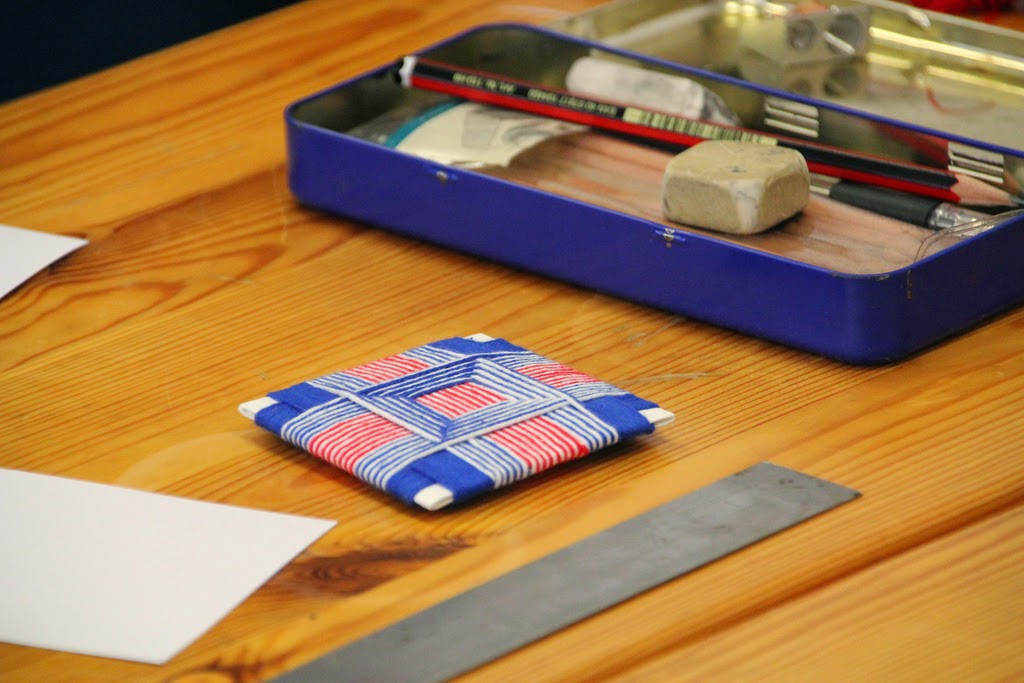
Amulet weaving

The day workshop on amulet weaving at Aro Ling Bristol attracted a delightful group of people. There were ten of us, which was about the right number for the space available. They all successfully made at least one amulet during the day, and several managed to make two.


I will be teaching a shorter workshop on amulets at Aro Ling Cardiff as part of the ‘Saturday Morning Samplers’ series that begins on May 3rd. The amulet workshop will be on May 24th, 10 - 12. The cost is £10 for adults and £3 for children. The number of places is limited, so booking is advisable.

Thursday, 6 March 2014

Vajra Romance

Romance as an aspect of Vajrayana practice that is little known in the West. We are teaching on this topic in Vienna this weekend. We look forward to meeting Vajrayana practitioners in Austria.


Tantric sexuality is a vast field of living knowledge in which coital union is infinitely modulated in terms of all the sense-fields. It voluptuates in: the soft silence of falling snow on bare branches; the succulent stickiness of a budding twig; the glorious unreserved unravelling of blossoms; and, the cool moist fire of autumnal foliage. It is the art of the way in which the eye sees, and the poetry of the way in which the ear hears. Eyesight penetrates visual phenomena, and is engulfed by the field of vision. Hearing penetrates sound and is engulfed by the auditory dimension. Every sense-perception and sense-field performs, and is performed by, the same ecstatic dance. Male and female qualities of existence are the play of reality itself. They continually interpenetrate and inter-engulf each other as nondual dance. The tantric vision of reality is one in which sexuality is the meaning of every nuance of existence. To see the colour of a bird’s plumage is to be in sexual embrace. Listening to the bowed strings of a cello is to be in sexual embrace. Inhaling the saline scent of sea air; savouring the taste of a heavily tannic wine; caressing the intriguing surface texture of a weathered stone; contemplating the delicate elaborations of a cognitive pattern; all these sensory communications are sexual embrace. They are self-communicated communication – and they are continuously arising from and dissolving into emptiness.

Entering the Heart of the Sun and Moon, Ngakpa Chögyam and Khandro Déchen, Aro Books, pg. 100